
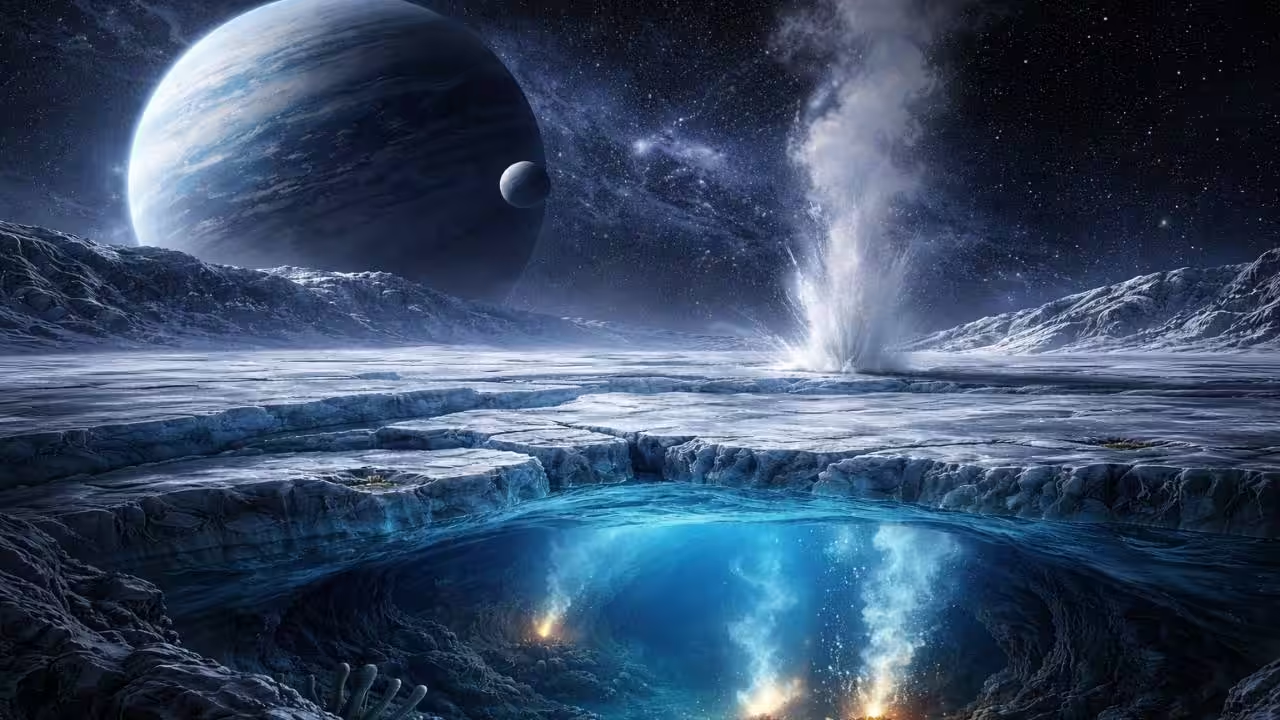
Modern space research is challenging the idea that life requires sunlight. Scientists now believe that life may exist in environments completely cut off from solar energy. Discoveries in deep ocean ecosystems on Earth have already shown that life can survive without sunlight by using chemical energy instead.
Attention has now shifted to icy moons in the Solar System, where subsurface oceans, internal heat, and chemical processes may create habitable conditions. Moons such as Europa and Enceladus are being studied closely because they contain liquid water and organic compounds, even though sunlight does not reach their oceans.
Table of Contents
New Scientific Understanding of Life Without Sunlight

Traditional biology has long been based on photosynthesis, where organisms convert sunlight into energy. However, scientists have identified ecosystems that function entirely without solar energy. In Earth’s deep oceans, organisms near hydrothermal vents survive through chemosynthesis, using chemical reactions instead of light.
This discovery has changed the definition of habitability. Instead of sunlight, life may only need three key conditions. These include liquid water, an energy source, and essential chemical elements such as carbon, hydrogen, and oxygen. These factors can exist on certain moons even in complete darkness.
Evidence of Subsurface Oceans on Icy Moons
One of the strongest reasons scientists believe life could exist without sunlight is the presence of subsurface oceans. Observations from spacecraft missions have confirmed that several moons have liquid water beneath thick ice layers.
Europa, a moon of Jupiter, is believed to contain an ocean with more water than all of Earth’s oceans combined. This ocean is kept liquid by tidal heating, a process caused by Jupiter’s strong gravitational pull. Enceladus, a moon of Saturn, also shows clear evidence of a global ocean. It releases water plumes into space that contain organic molecules and salts.
These oceans are considered stable environments that could support life for long periods, possibly billions of years.
Internal Heat as an Alternative Energy Source
Moons without sunlight rely on internal heat instead of solar energy. Tidal heating plays a major role in maintaining these environments. As a moon orbits its planet, gravitational forces stretch and compress it, generating heat within its interior.
Another source of heat comes from the radioactive decay of elements in the moon. This process provides additional warmth, helping keep subsurface water in liquid form. Together, these heat sources can sustain oceans and chemical reactions even in the absence of sunlight.
Even in areas far from the Sun, scientists believe that tidal heating can sustain liquid water’s temperatures.
Hydrothermal Activity Supports Life in Darkness
Hydrothermal vents are considered one of the strongest indicators that life could exist on sunless moons. On Earth, these vents release hot, mineral-rich water from the ocean floor, supporting diverse ecosystems.
Research suggests that similar hydrothermal activity may exist on Enceladus. Data collected by spacecraft indicate the presence of hydrogen gas and organic compounds, produced when water interacts with rock at high temperatures. This process can provide a continuous energy source for microbial life.
Hydrothermal systems can persist for millions or even billions of years, providing a stable environment for life to develop and evolve.
Comparison of Earth and Ocean Moons
| Feature | Earth Surface | Ocean Moons |
|---|---|---|
| Main energy source | Sunlight | Chemical energy |
| Light availability | Present | Absent |
| Water location | Surface oceans | Subsurface oceans |
| Life status | Confirmed | Not confirmed |
This comparison highlights that sunlight is not the only pathway for sustaining life. Chemical energy can support biological processes in completely dark environments.
Enceladus and Europa Remain Key Targets
Enceladus is currently one of the most promising locations for extraterrestrial life. Its water plumes contain organic molecules, salts, and hydrogen, which are considered essential for life. Scientists have found evidence of chemical reactions similar to those that support life on Earth’s ocean floor.
Europa is also considered highly important in the search for life. Its ocean is believed to be in contact with a rocky seafloor, allowing chemical interactions that could produce energy. Although there are uncertainties about the level of geological activity, the moon remains a major focus of upcoming missions.
NASA’s Europa Clipper mission is expected to provide more detailed information about Europa’s ice shell, ocean composition, and potential habitability.
Factors That Could Support Life
Scientists have identified several conditions that increase the chances of life developing on moons without sunlight.
- Presence of liquid water beneath ice layers
- Continuous chemical energy from hydrothermal activity
- Availability of organic molecules and essential elements
- Long-term environmental stability
- Protection from radiation by thick ice shells
These factors together create conditions that may allow microbial life to form and survive.
Challenges in Confirming Life
Despite the promising conditions, several challenges remain. One major difficulty is the thick ice covering these oceans, which makes direct exploration extremely difficult. Current technology cannot easily reach the ocean beneath the surface.
Another limitation is the lack of direct evidence. Scientists have discovered numerous ingredients for life, yet they have not detected any living organisms on any moon to date. The limited energy availability on Earth could hinder the development of complex life.
Future missions will need advanced tools to collect samples and analyze chemical signatures that could indicate biological activity.
Future Missions Aim to Find Answers
Space agencies are planning several missions to explore ocean worlds in more detail. The Europa Clipper mission will study Europa’s environment and look for signs of habitability. Scientists are also developing concepts for missions to Enceladus that could directly sample its plumes.
Some proposals include sending probes that can melt through ice and reach the subsurface ocean. These missions aim to detect biosignatures such as organic molecules or chemical imbalances that may indicate life.
Research suggests that signs of life could exist just beneath the ice surface, making them easier to detect without drilling deep into the ocean.
Scientific Outlook Remains Promising
The study of ocean moons has expanded the understanding of where life can exist. Scientists now consider that habitable environments may not require sunlight at all. Instead, internal heat and chemical energy may be sufficient to support life.
Moons like Europa and Enceladus remain among the most promising locations in the search for life beyond Earth, despite the lack of direct evidence. Future discoveries may confirm whether life can begin and evolve in complete darkness, changing the understanding of life in the universe.